
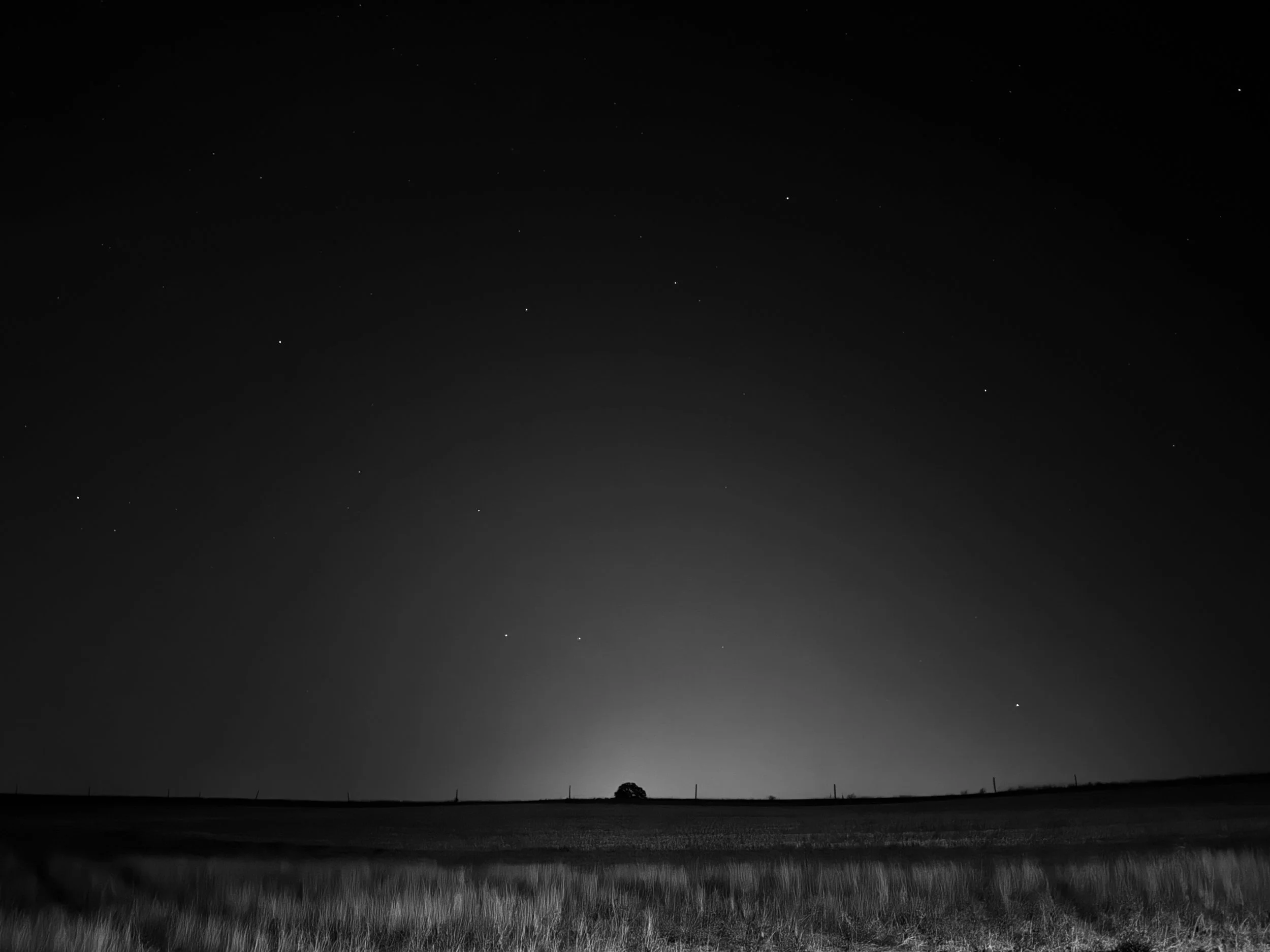
A few weeks ago, a good friend of mine sent me an Instagram reel.
The title was The Darkness Between the Stars Shouldn’t Be There.
I watched. This friend? It seems he knows me quite well, because from that day on, every time I walked at night, I had to look at the sky. Curiosity was crawling up my spine.
Really? There shouldn’t be darkness in the sky?
A few days later, on the 13th of August, under a clear Basel-Land sky, I counted seven shooting stars. The Perseid meteor shower had gifted me seven wishes during a difficult time. And, somehow, a little hope.

The night of the Perseids. Basel-Land, 13 August 2026. Shot on iPhone.
Eventually, curiosity completely took over my brain and led me to Olbers' paradox—which, of course, turned out to be the subject of the reel my friend had sent me.
Imagine standing in an endless forest. No matter which direction you look, you end up seeing a tree. Olbers argued that an infinite, eternal and static universe full of stars should work in a similar way: wherever we look, we should eventually see a star. The entire night sky should therefore be bright, full of light.
But it isn’t.
Little voice in my head:
Rubén, why isn’t it enough to know? The Sun went down. Now it’s dark.
End debate.
Nope.
I guess we have this need to understand things—even things we perhaps never will.
So, why is it dark?
In short:
The universe hasn’t existed forever. Some light simply hasn’t had enough time to reach us.
Was my curiosity satisfied?
More or less.
Then I learned that what we call visible light is only a tiny fraction of the electromagnetic spectrum. Our eyes simply weren’t built to see the rest. Some animals can see wavelengths of light that we cannot, and we humans eventually built instruments capable of detecting far beyond the limits of our eyes: infrared, ultraviolet, radio waves, X-rays...
I mean, we do learn this at school, but... let's say it hit me differently this time.
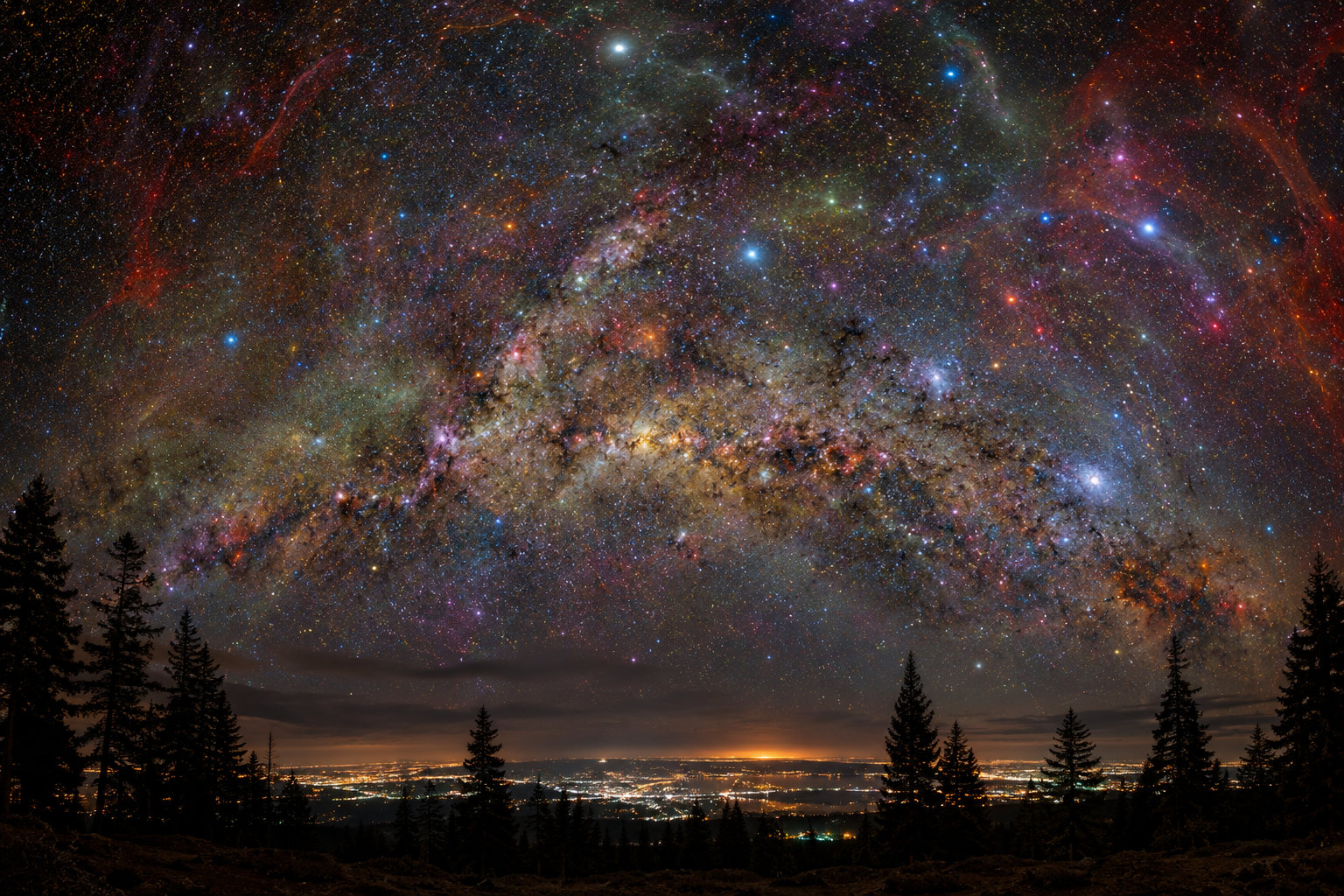
So I asked ChatGPT: Could you recreate an image of how the night sky might look if we could see the entire spectrum of light at the same time?
Of course, what it gave me was only an artistic approximation. But it looked something like this:
And down the rabbit hole I went.
But wait, was I still thinking about the sky at all?
Down the Rabbit Hole
This is not the first time I have written about light and darkness. Somehow, it is a subject that has always been present in my thoughts.
Perhaps in yours too?
I don’t think I am alone in this one.
I have made life-changing decisions chasing one and escaping the other. I have spent much of my life identifying, hiding, improving or polishing what I considered my darker parts.
At times, I have looked for light in other people because I did not trust my own. To be more honest, for most of my life, I thought there was no light in me at all. Which explains my obsession with improving or getting rid of the “darkness.”
And if that's how I've judged myself, what about others?
🤯🤯🤯
I wonder how many times I have judged people, mistaking what I could see in them for everything that was there.
But now, when I look at a dark night sky, I know I am not necessarily seeing everything that is there.
What if some of the things I see as darkness within myself really are dark, but that doesn’t mean darkness is all there is? What if there is light there too, light that I simply haven’t learned to see yet?
What is darkness?
If you ask Augustine of Hippo:
Darkness only exists where light is absent. Much like evil, which is not something that exists on its own, but the corruption or absence of good.
If you Google it:
Same thing, just shorter and without the evil shit.
And perhaps that's the frustrating part about learning to see differently: it takes time. Some of our own instruments take years to build.
That sucks.
Sometimes it really feels like we live in a video game.
You face the boss without the weapon you need. You fail again and again. Eventually, you defeat it.

And your reward is... the weapon that would have made defeating it much easier in the first place.
It gets worse. No game here. Real life, my friends. Just one try!
What a pain.
When we look farther into the universe, we are actually looking into its past. The light reaching us from distant stars and galaxies left them millions or even billions of years ago.
I wonder if some things from our own past also take time to reach us—not as memories, but as understanding.
Our oldest experiences. Our farthest memories.
Not just to remember the past, but to see it differently. By then, we have instruments we didn't have before: experience, pain, distance, the way we love—and yes, all those euros spent on therapy.
The past doesn’t change; the observer does.
Still, I find it ironic. Something that once seemed crystal clear—light is good, darkness is evil—became less clear the further I fell down this rabbit hole.
Supposedly, I now have better “instruments.”
And yet, I know less. I have no idea.
I have become an agnostic of light and darkness—in myself, in the people I love and in those I still don't know.
Maybe a better telescope doesn't reveal a prettier universe. It reveals more of the universe.
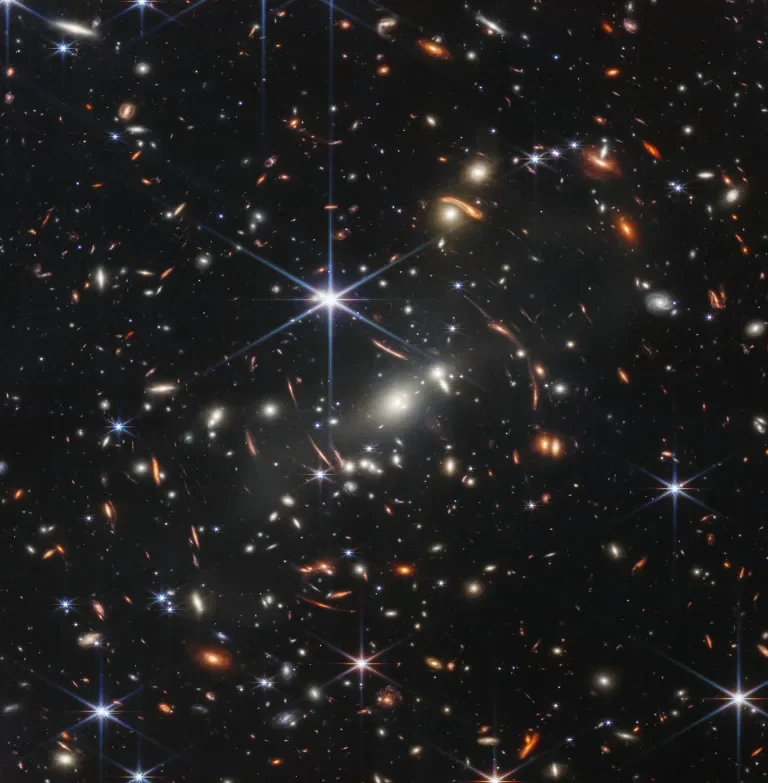
Webb’s First Deep Field — SMACS 0723
The deepest and sharpest infrared image of the distant universe at the time of its release. This entire image represents a piece of sky approximately the size of a grain of sand held at arm’s length.
NASA / ESA / CSA / STScI